
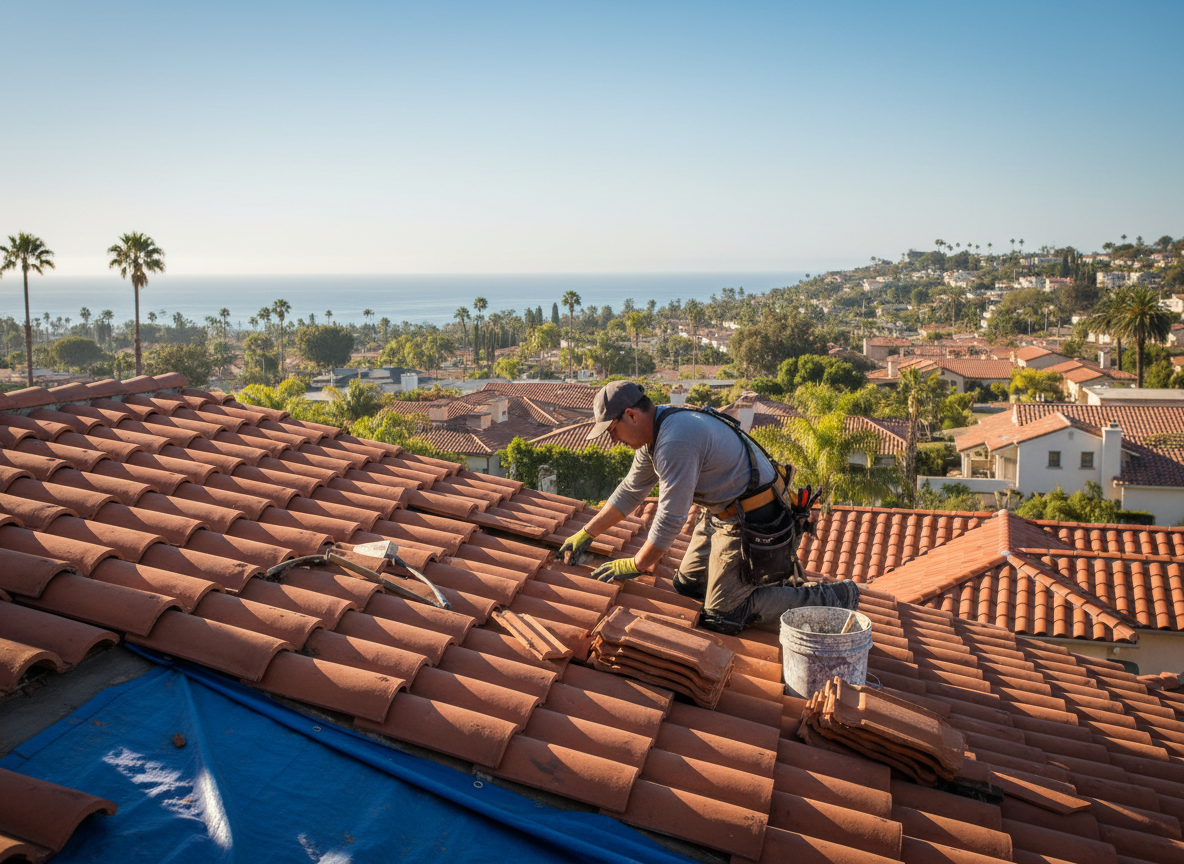
San Diego's mild Mediterranean climate still brings concentrated winter downpours that drive water under lifted or cracked clay tiles, especially on homes built in the 1960s through 1980s in North Park and Mission Valley. These neighborhoods feature many two-story stucco houses with barrel and S-tile roofs where the original underlayment has reached the end of its service life. A single missed broken tile near a valley or ridge can send water into the attic and down interior walls within one season.
Coastal exposure in Pacific Beach and La Jolla adds constant salt spray that degrades mortar and metal flashings faster than inland areas like La Mesa. When repairing tile roofs here, crews must match the existing profile and color exactly, because modern concrete tiles differ in weight and profile from older clay units still common on streets near Balboa Park. Reusing sound tiles and replacing only damaged ones keeps load calculations within original design limits and avoids triggering full re-roof permits in most cases.
Edge flashing, step flashing at walls, and ridge cap detailing require extra attention on the steeper pitches found in Coronado and Downtown San Diego hillside homes. Technicians inspect the full deck for dry rot caused by previous leaks before resetting tiles, because hidden damage under the underlayment often extends several feet beyond the visible wet spot.
San Diego County building practices require proper ventilation and ice-and-water shield at eaves when any underlayment work is performed, even though true ice dams are rare. Homeowners in Chula Vista and La Mesa frequently discover that skipped valley repairs lead to repeated interior staining after each El Niño winter.
Technician insight
In San Diego the thing that catches most people out with Tile Roof Repair is how fast salt air in Pacific Beach and La Jolla corrodes the metal valleys while the tiles themselves still look fine; homeowners wait until water stains appear inside, but by then the underlayment has already failed for several feet on either side of the valley on 1970s homes.
North Park Tile Leak After Winter Rain
Homeowner noticed ceiling stains after January storms. Inspection found lifted tiles and rotted underlayment along a valley on a 1978 barrel-tile roof. Crew replaced the valley metal, patched synthetic underlayment, and reset original tiles. No further leaks reported the following winter.
Tile Roof Repair Services We Offer
✓Cracked Tile Replacement
Remove and replace individual cracked or spalled tiles while preserving surrounding courses on older clay roofs common in North Park and Mission Valley.
✓Valley Flashing Repair
Inspect and replace corroded or lifted metal valleys that allow water intrusion during San Diego's winter rains on tile roofs near Balboa Park.
✓Ridge Cap and Hip Sealing
Re-bed loose ridge and hip tiles with fresh mortar or foam adhesive to stop wind-driven rain entry on exposed La Jolla and Pacific Beach homes.
✓Underlayment Patch and Repair
Cut out failed felt or synthetic underlayment sections and install new material beneath existing tiles without full roof removal.
✓Chimney and Wall Flashing Repair
Re-seal or replace step flashing and counter-flashing where tile meets stucco walls on two-story homes in Coronado and Downtown San Diego.
✓Tile Color Matching and Sourcing
Source matching barrel or S-tiles for discontinued profiles found on 1970s–1980s homes throughout San Diego County neighborhoods.
Tile Roof Repair Cost in San Diego, CA
| Service | Typical Range | What Affects It |
|---|---|---|
| Single tile replacement | $75–$150 | Higher on two-story homes or steep pitches in La Jolla |
| Valley flashing repair section | $350–$650 | Depends on length and whether deck repair is required |
| Ridge cap re-bedding per 10 linear feet | $180–$320 | Mortar versus foam adhesive choice affects cost |
| Underlayment patch (4x8 section) | $400–$750 | Includes tile removal and reset around the area |
Ranges are typical for San Diego, CA and confirmed with an exact written quote before any work starts.
How it works
- 1
On-Site Inspection
Technician climbs the roof from 519 University Ave service area to map every damaged tile, check valleys, and assess underlayment condition.
- 2
Material Matching
Identify existing tile profile and source compatible replacements before any work begins on La Jolla or North Park properties.
- 3
Targeted Removal And Repair
Lift surrounding tiles, replace or patch underlayment, install new flashing where needed, then reset or replace tiles.
- 4
Final Seal And Walk-Down
Apply approved sealant at all reset ridges and valleys, then walk the roof to confirm no loose tiles remain.
Pricing
Upfront written quotes after inspection; price varies by roof access, tile type, and extent of underlayment damage.